


Immersed in the Agricultural Landscape: Following the Centuries- Old History of Water Management
Information
A completely flat, 61-kilometre circular route that winds through some of the most characteristic landscapes of the western Bologna plain, following the course of the River Reno and the land reclamation works which, over the centuries, have transformed a territory once dominated by water into an agricultural landscape of extraordinary balance, offering a wealth of points of interest in terms of history, nature and hydraulic engineering. Starting right from the centre of Bologna, the route takes you from the urban environment to the tranquillity of the riverbanks and reclaimed countryside in just a few kilometres.
The route starts at eXtraBO, in the heart of Bologna, and heads north-west along Via Lame. At Trebbo di Reno, you join the Ciclovia del Reno cycle route, which takes you to the small historic village of Malacappa, which grew up along the ancient routes linking Bologna with the lower plains. Just beyond Malacappa, as you descend from the embankment, you’ll travel along one of the most picturesque stretches of the entire route: around three kilometres of tree-lined avenue flanked by majestic, centuries-old English oaks, with the 17th-century Villa Sampieri Talon on your left. The route continues to the village of Volta Reno: take the cycle path along the SP 42, entering the territory of Castello d’Argile, a village of medieval origins linked to the history of land reclamation and flood defences in the plain.
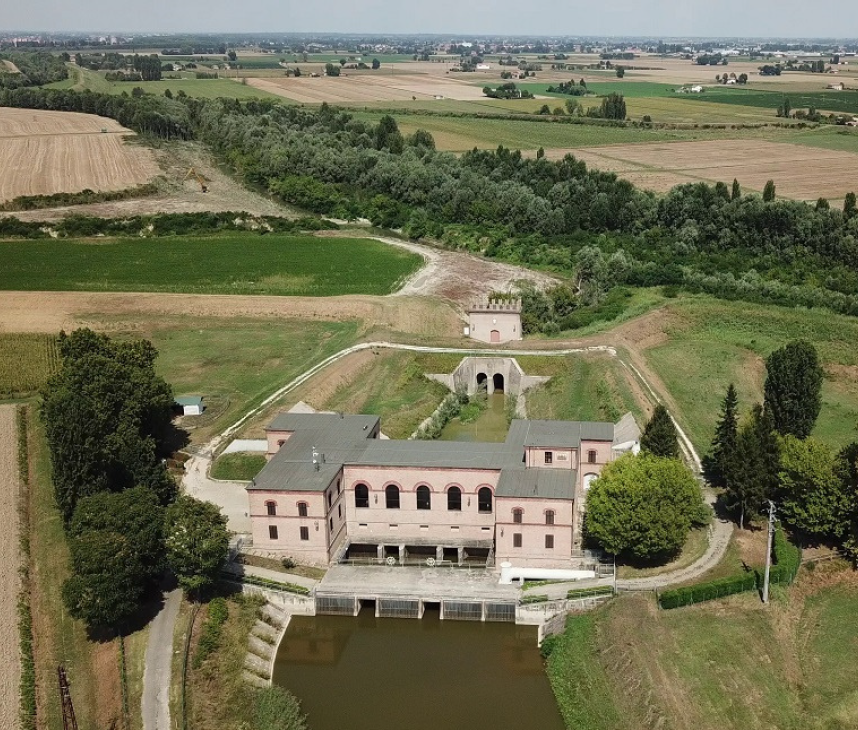
Leaving the village via Via Suore, you reach Palazzo Minelli – a former convent and now a manor house set in the countryside – and then the ancient bridge over the Reno near Bagno di Piano. A short detour takes you to the Chiavica Sostegno, an important hydraulic structure that regulates the water levels of the canal. Resuming the route, turn onto Via Conte, from where the modern Il Conte pumping station is clearly visible – a key component of the current drainage system. A little further on, you reach Palazzo Zambeccari, known as ‘Il Conte’, from which a dirt track leads to the historic Bagnetto of Sala Bolognese pumping station.
Returning to Via Carline, you follow the embankment of the Canale delle Acque Basse, running alongside the renaturalised Dosolo floodplain. Passing through Via Fabbreria, Via Longara and Via Aldina, you finally return to the Dallabetta Bridge before heading back to Bologna, completing a route that illustrates the deep relationship between humankind and water.
These landscapes of the Bologna plain, with their rural architecture, irrigation systems and wide open spaces, amongst other things, have repeatedly provided evocative backdrops for Italian cinema. For example, Palazzo Minelli was chosen as a filming location for La mazurka del barone, della santa e del fico fiorone (1975), directed by Pupi Avati and starring Ugo Tognazzi, Paolo Villaggio, Lucio Dalla and Gianni Cavina, and for L’affittacamere (1976), a film by Mariano Laurenti starring Gloria Guida, Lino Banfi and Enzo Cannavale. Meanwhile, the Il Conte water pumping station was chosen by the Manetti Bros. as one of the locations for the film Diabolik (2021).


map Stages
-
1
eXtraBO - the hamlet of Malacappa
-
2
The hamlet of Malacappa - Palazzo Minelli
-
3
Palazzo Minelli - The Bagnetto water-pumping station in Sala Bolognese
-
4
The Bagnetto water-pumping station in Sala Bolognese - eXtraBO
bar_chart Technical Info
- Km: 61 km
- Stages: 4
- Regions: 1
Elevation gain: negligible
Terrain: gravel and tarmac
Suitable for: cycle touring, gravel biking, e-bikes
Journey time: approximately 4.5 hours (excluding stops and sightseeing)
The route has been designed to prioritise cycle paths and quiet, mixed-traffic minor roads. Where this has not been possible, the route includes short stretches on busier roads. In all cases, you are advised to exercise the utmost caution and always observe the Highway Code.
Technical cycling clothing
First aid kit
GPS navigation system
Telephone and charger + power bank
The cycle route is accessible all year round. The best times to visit are definitely the spring months, when you can enjoy the blossoms and mild climate, and early autumn.
During the summer season, particularly in July and August, it is not recommended due to the high temperatures, and winter is also not recommended due to the risk of snow, rain and fog.
